
Straight and Racked Stitches in the Same Row
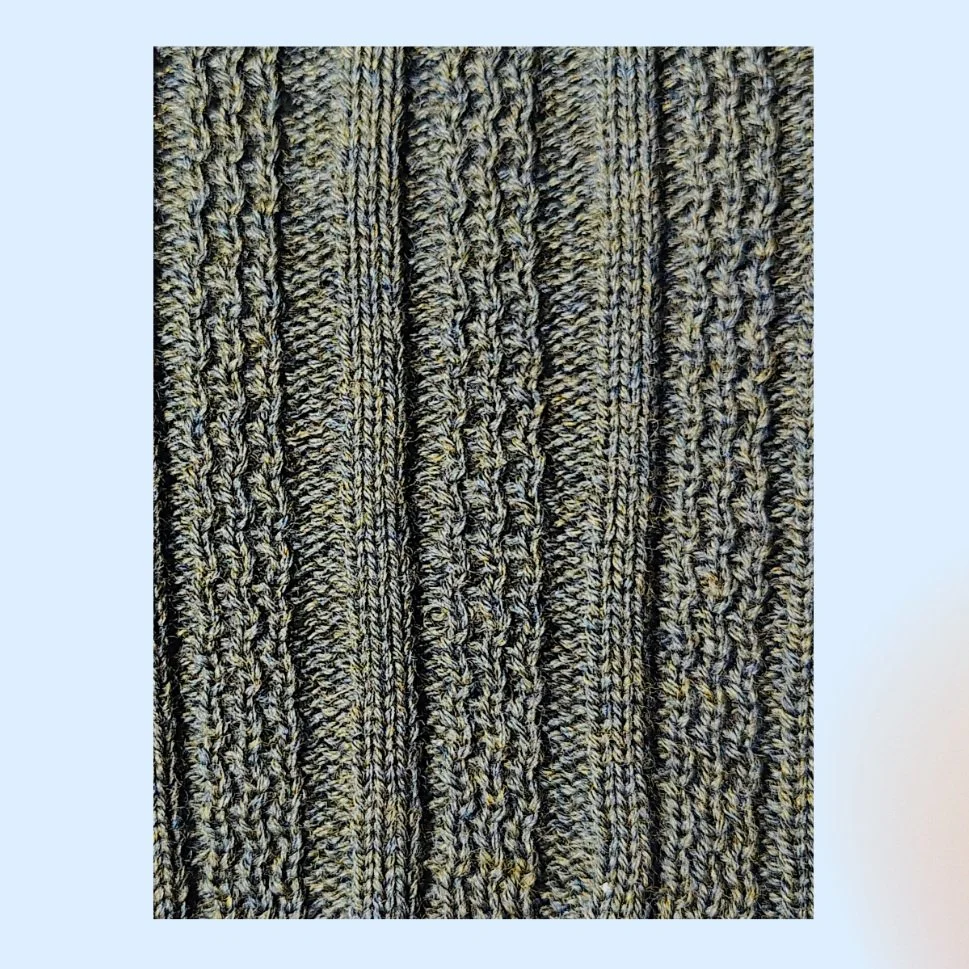
The video below demonstrates one of the key principles of racking. If you’ve been machine knitting for a while, you may enjoy seeing this rule in action. If you’re new to the craft, the video offers a glimpse of the kinds of structures and textures machine knitting makes possible.
While the featured swatches were knitted on the Kniterate, the core demo takes place on a manual Passap machine. The same stitch pattern can also be worked on a Japanese-style machine equipped with a ribbing attachment.
This video marks the beginning of a YouTube relaunch. I invite you to subscribe.
Video Transcript
This swatch might look complicated, but it’s actually just a clever stitch arrangement and a technique called racking on a double-bed knitting machine. In this video, I’ll show you a couple of favorite swatches and then give you a quick demo of how to have straight stitches and slanted stitches all in the same row.
Hi, I’m Olgalyn Jolly. I’ve been working with knitting machines for decades—designing, experimenting, exploring stitch patterns, and teaching. I help machine knitters learn about knit structure so they can do their most creative work. Stockinette in the right fiber can be lovely, but we can do so much more with our machines.
This channel was actually started during the pandemic lockdown, when I was still teaching at the Fashion Institute of Technology, here in NYC. So if you hear horns honking and sirens sounding, I’m sorry I can’t help that! I was teaching remotely and this channel was full of demos on the Zippy Loom. Knitting machine faculty taught on the Zippy, because we couldn't insist that students all buy knitting machines. But students could learn the basic knitting machine operations on the zippy.
I'm relaunching this channel, inspired by the other YouTube machine knitters. I want to contribute what I love knitting most on the machines – texture. What keeps me fascinated is the variety of textures you can create by repeatedly pulling one loop through another and by shifting stitches. Just a handful of operations can lead to the most amazing structures.
I’m showing two intermediate level swatches today. This is what I call a mock crochet stitch. It has a really open, fancy mesh look, and people often think it must be complicated. But really, it’s just a smart use of ribs, racking, and needle arrangement.
And here’s another! This one has both straight ribs and subtle zigzag ribs repeated across the swatch. This one looks simple, but the setup is a little complex. It’s a variation of a stitch pattern you may have seen in the machine knitting pattern books.
This particular swatch was prompted by a question from an enrollee in one of my courses. Anne has a love of experimenting with stitches, as I do. We always ask the what-would-happen questions like
What would happen if I knitted this pattern with a smaller stitch size on the back bed?
What would happen if I tucked going in one direction on the front bed?
What would happen if I made the ribs a little bit wider?
That’s what Ann was working on. She wanted to place three or more straight stitches and three or more slanted stitches in the same row with a couple of purls in between. The pattern books just show this pattern with ribs that are two stitches wide. Here's the problem. If you add just one stitch to each rib to make it wider, the pattern of straight ribs and zigzags gets messed up. You don’t get distinct groups of straight ribs and zigzag ribs. But there is a way to do it, and I’ll get to that in a moment.
For the record, I knitted both of these swatches on the Kniterate. But here's the important part: they can be knitted on any double bed machine with racking capabilities. That means you can probably knit this on your machine if your machine has two beds.
Racking shifts one knitting bed in relation to the other bed. Your machine might rack either the front bed or the back bed. If your machine is a Superba or a Japanese-style machine like a Brother or a Silver Reed, the front bed will be moving. If it's a Passap, Kniterate, or Dubied, it's the rear bed that racks.
I'm going to show you how to set up this pattern on a manual machine right now.
Here's the needle arrangement. The vertical lines on top represent the needles in action on the back bed, also known as the main bed on the Japanese-style domestic machines. The vertical lines at the bottom represent the needles in action on the front bed or the ribber on the Japanese-style machines. The dots represent the needles out of action.
When I turn the racking handle, my back bed shifts sideways on this Passap machine. That's the start of making slanted stitches, but it's not that simple. One of the rules of racking states that in order for a slanted stitch to show, one stitch must pass in front of or behind another stitch. You can see those stitches slant as I rack.
You then need to knit a row with the needles in the new position to lock the slanted stitches in place. You'll see slanted stitches on your swatch. All the places where the stitches on the beds have crossed each other are the places where the slanting of the stitches will remain after you knit another row to lock the slanted stitches in place. When a stitch does not cross in front of or behind another stitch, you'll have straight ribs.
Sometimes we need to have needles out of action to keep the front and back bed stitches from crossing. Whether you rack to the right first or to the left first will depend on whether your front bed is racking or your back bed is racking. Just pay attention to which stitches are crossing others on the opposite bed when you rack. With this particular setup and my rear bed racking machine, I’ll be racking to the left first.
And that's just part of it. The rules of racking are fascinating. We go deep in my racking workshop.
But let's get to the knitting sequence. Remember we want certain stitches to cross to create the subtle zigzags:
Rack in your first direction
With both beds set to knit, two carriage passes
Rack back
Two carriage passes
That's the whole sequence. Now repeat.
Go ahead, give it go. Play around with the stitch size, tension, and type of fiber. If you’re really adventurous, increase the number of stitches in a rib. If you do make wider ribs, remember to add out-of-work needles to control which stitches are doing the crossing.
Here are two stitch patterns I showed earlier with different yarns — the mock crochet, with its airy, open texture, and the swatch that has both straight ribs and zigzags, this time without plating. Both are good examples of how racking can totally transform ribs.
And that’s what I love about machine knitting and developing stitch patterns — sometimes it’s complicated and sometimes it’s straightforward. But it’s always interesting and fun to figure out.
So I hope you’ll join me on this channel! I’ll be posting stitch patterns and some of my projects and tips.
O!
Reclining woman in cream cardigan photo © 2019 The Taunton Press, Inc. Photo: Jack Deutsch, courtesy of Threads magazine.