
Purl Knit or Links-Links and What’s a Horizontal Rib?
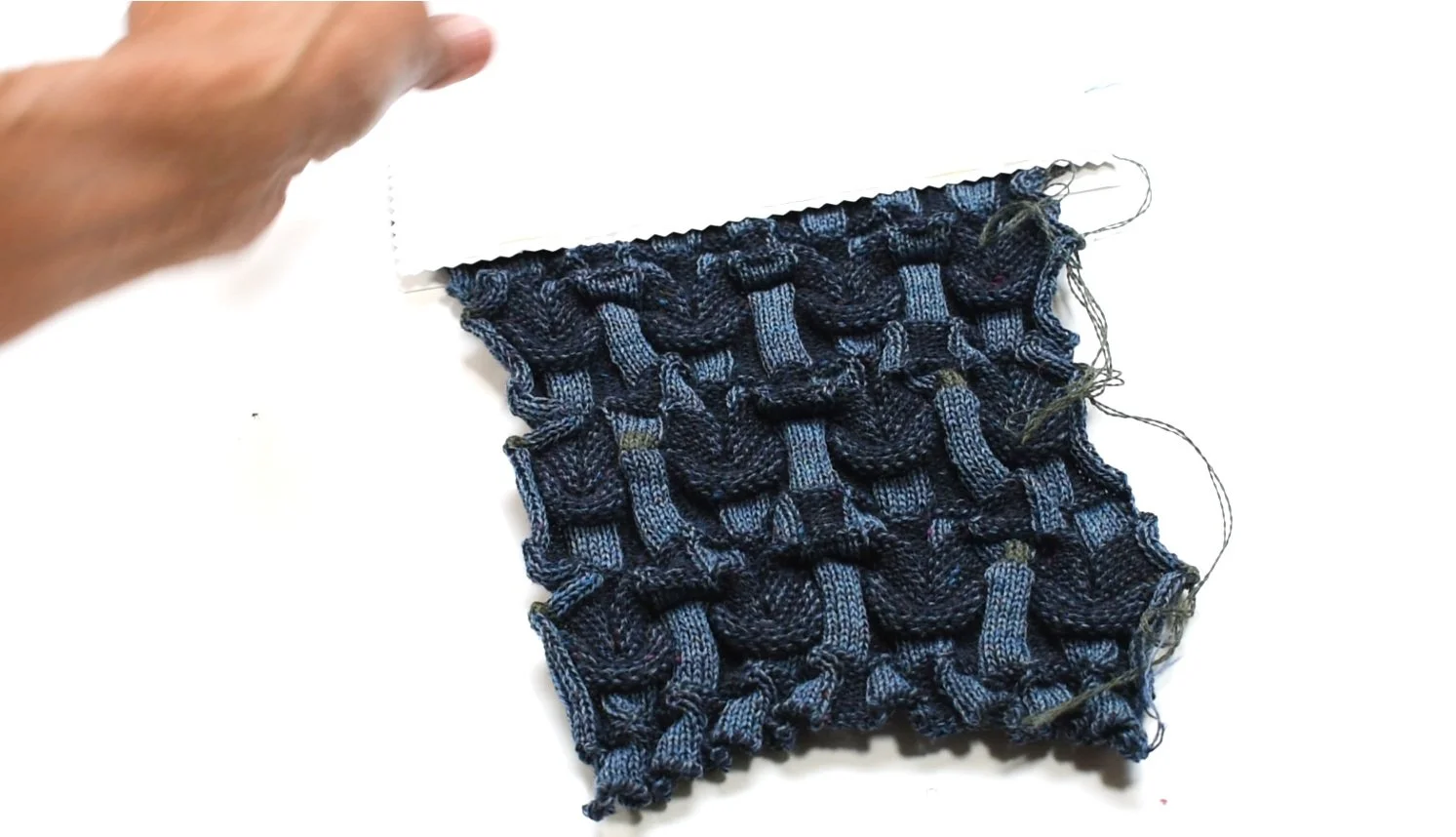
In this video, I revisit one of the stitch patterns from Inspiration or Iteration, posted earlier this year. I knitted this swatch on the Kniterate, yet despite its intricate appearance, this purl knit structure can be created on any double bed machine. The video below outlines several ways to move the process forward on different machines, including a walkthrough of how I programmed the pattern in the Kniterate design app.
More videos are on the way. I invite you to subscribe to my YouTube channel.
Related Links
Download the stitch block image files and templates [email required]
vanderwool_knitting [on Instagram]
Prior Purl knitting machine photo [on knittingmachinemuseum.com]
Pingoin Garter Stitch Machine [M. Bloice on knittingmachinemuseum.com]
Garter stitch on the Hamanaka Needle Machine [Nix Knits on YouTube]
Prior Purl Machine does garter stitch [Nix Knits on YouTube]
Five hours of garter carriage [KnitFactoryImpl on YouTube]
Structural Stitches [V. Salmon on anotherknitteedthing.com]
Multifunctional Foldable Knitted Structures: Fundamentals, Advances and Applications [A. Pavko-Čuden and D. Rant on ResearchGate.net]
Video Transcript
This type of fabric is called a purl knit or a links-links fabric, and I’ve wanted to knit this type of swatch for a very long time. I finally knitted it a couple of months ago. Why did it take me so long? How did I knit it? What will it become?
Hello, I’m Olgalyn and I want to talk a little about this fabric. It’s not a jersey knit with knit stitches on one side of the fabric only. It’s not a rib knit with separate wales for the knits and separate wales for the purls. It’s called a purl knit or a links-links fabric. I’ll use the terms interchangeably.
What distinguishes it is that the knits and purls appear in the same column or wale. Zooming in on this swatch, I’ve used plating with the light and dark blues. There's a reverse jersey and both 6x6 ribs and 18x6 ribs.
Back in the 1980s, when I took a weft knitting technology class at the Fashion Institute of Technology, we were introduced to this kind of fabric and shown an actual industrial links-links machine. Links is German for left and we were given an explanation as to why this machine was called links-links. But that was a long long time ago and I can’t remember. But if you happen to know, please share your knowledge in the comments. More on the machines in a moment.
If you’re a hand knitter, this type of fabric is relatively easy to knit. In fact, this type of stitch may have been the very first stitch you learned because a garter stitch is probably the most basic links-links stitch. When you hand-knit a garter stitch, each time you turn your knitting to the purl side to begin a new row, you’ll be forming the new knit stitches on top of purls, which means you are going to get knits and purls in the same wale.
Now, about the machines. I already mentioned the industrial links-links machine I saw many years ago. At one time, home versions of links-links or purl machines were manufactured in Japan and France.
This one from Japan is the Hamanaka Needle Machine. A big thank you to VanderWool Knitting, who allowed me to use these photos.
Check out the needle! It gives you a hint as to how the machine knits the fabric. Each needle has two hooks, one on each end, so the needles can form a knit stitch on either end. That’s how they produce the garter stitch. Stitches are formed with the hooks on one side of the machine. As the row is knitted, the needles are moved to the other side of the machine, and the hooks on the other side of the needle knit the next row. So you never turn the fabric, as with hand knitting or with a garter bar. This is similar to the way industrial links-links machines work.
If you want to see the Hamanaka needle machine in action, check out the videos from Nix Knits. I’ve linked to the garter stitch video in the description. And there are links to photos of other vintage purl knitting machines on my site.
As I’ve mentioned, unlike a jersey knit or a rib knit, a purl knit has both knits and purls in the same column or wale. As a machine knitter, I’m sure you've observed the properties of jersey, also known as stockinette. You know how the bottom and top of the fabric roll toward the knit side. And the selvages roll toward the purl side. Those same rolls occur within this fabric.
If you look closely, you can see this swatch gets all its texture from the natural roll in the fabric. Think of each little section as a little piece of jersey with its rolls on the edges. Each little jersey area does its curling thing and interacts with the other little jersey sections.
You see little areas of jersey and little areas of reverse jersey. The tops and bottoms of the jersey sections curl toward the knit. The sides roll toward the reverse or purl. Each area of knits or purls has an effect on the adjacent section, sometimes pulling or pushing it into an unexpected shape. As the pattern is repeated horizontally and vertically, a complex pattern develops.
Depending on the machine you're using, there are a few approaches to knitting this type of stitch pattern:
If you knit on a single bed, you can use a garter bar to knit a garter stitch. Unfortunately, if you want to do something more complicated, you will need to reform some of the knit stitches manually.
If you have the right type of machine for a garter carriage and All Yarns Are Beautiful software, you can easily knit this type of fabric. In fact, KnitFactoryImpl has five hours of knitting a links-links fabric with a garter carriage and AYAB software. The video is linked in the description. Since I’ve never owned a garter carriage or worked with AYAB software firsthand, I don’t know for sure, but if you have this setup, you can probably knit my stitch pattern with my PNG, which you can download from my website.
Are you a Passap knitter with a U80 or a U100 transfer carriage? Well, follow my spreadsheet, bring your pushers into working position whenever you need to transfer, and use your transfer carriage with the lever set to “1” to make the transfers.
Here are two more possible scenarios:
You have DesignaKnit and a manual machine. I’d import the PNG into Graphics Studio and then run Interactive Knitting and allow the software to signal on which rows to transfer.
Or if you have a manual Brother machine, you could program a card to select needles only when you’re on a row with transfers. And then make the transfers manually to or from the main bed.
Now, I knitted this swatch on the Kniterate. Even if you don’t knit with a Kniterate, this may give you ideas on how you may want to think about and create your own textured purl knit stitch pattern.
I used this stitch block that I showed earlier. It’s 24 by 40 pixels. I made my PNG in GIMP, but it can be made in any software where you can draw an image in pixels. In this case, each black pixel represents a stitch that's knitted on the front bed. Each white pixel represents the purls, knitted on the rear bed. This is the same pattern I have available on a spreadsheet, in case you want to use it as a guide to knit this pattern on another type of double bed machine.
In the Kniterate app, I imported the stitch block. Once I added the second color, edited the options columns for speed, roller value, and stitch size. After positioning on the bed, I tiled the pattern in both directions.
Zooming in, you can see this pattern starts out just like a 6x6 rib with 6 stitches on the front and 6 on the rear. When I get to row 10, transfers need to be made, so I added the front-rear transfers command with the mode: between rows. I added waste and cast-on and the bind-off.
For those not on a Kniterate or without a garter carriage or transfer carriage, yes, if you enjoy hand manipulation, you can do the transfers manually. Follow this chart, and transfer stitches to the opposite bed as indicated. Again, black boxes are stitches on the front bed or ribber. White cells are stitches on the rear or main bed.
If you want another conceptual approach to purl fabrics, be sure to check out this book by Victoria Salmon, Structural Stitches — A Machine Knitter’s Guide to Creating Form and Texture. The whole book is great, and I’m sure I’ll talk more about this book in the future. But if you want another approach to purl knit fabrics, look at chapter 3, “Transfers and Rib Structures”.
Victoria’s general explanations are a little different than mine. In fact, when describing these particular links-links structures, she refers to vertical ribs and horizontal ribs. Interestingly, I’ve never heard the term horizontal ribs before. Sometimes I’ve heard garter ridge referred to as mock horizontal ribs. But after thinking about it a moment, I do get the idea. And I don’t know, there may be whole continents of knitters approaching it this way.
In any case, the results and type of fabric are the same. And several pages into the chapter, Victoria has charts and photos of gorgeous links-links fabrics. I highly recommend this book.
What’s next for me? I’m seriously considering making a cardigan out of this stitch pattern once I figure out which yarn I’m using. And this is a big deal for me, because I only average about one sweater a year these days. So, I hope you follow along to see where I go with this.
‘Til next time!
O!
If you’re a Kniterate user, my prerecorded Designing with Kniterate - Session 3 The Tuck Loop (Plus Plating) provides instruction on using the Stitch Image and the Front<>Rear Transfer commands. If you’re not an owner yet, I’d be happy to give you a virtual tour of the machine.