
A Fun Chat with Susan Guagliumi
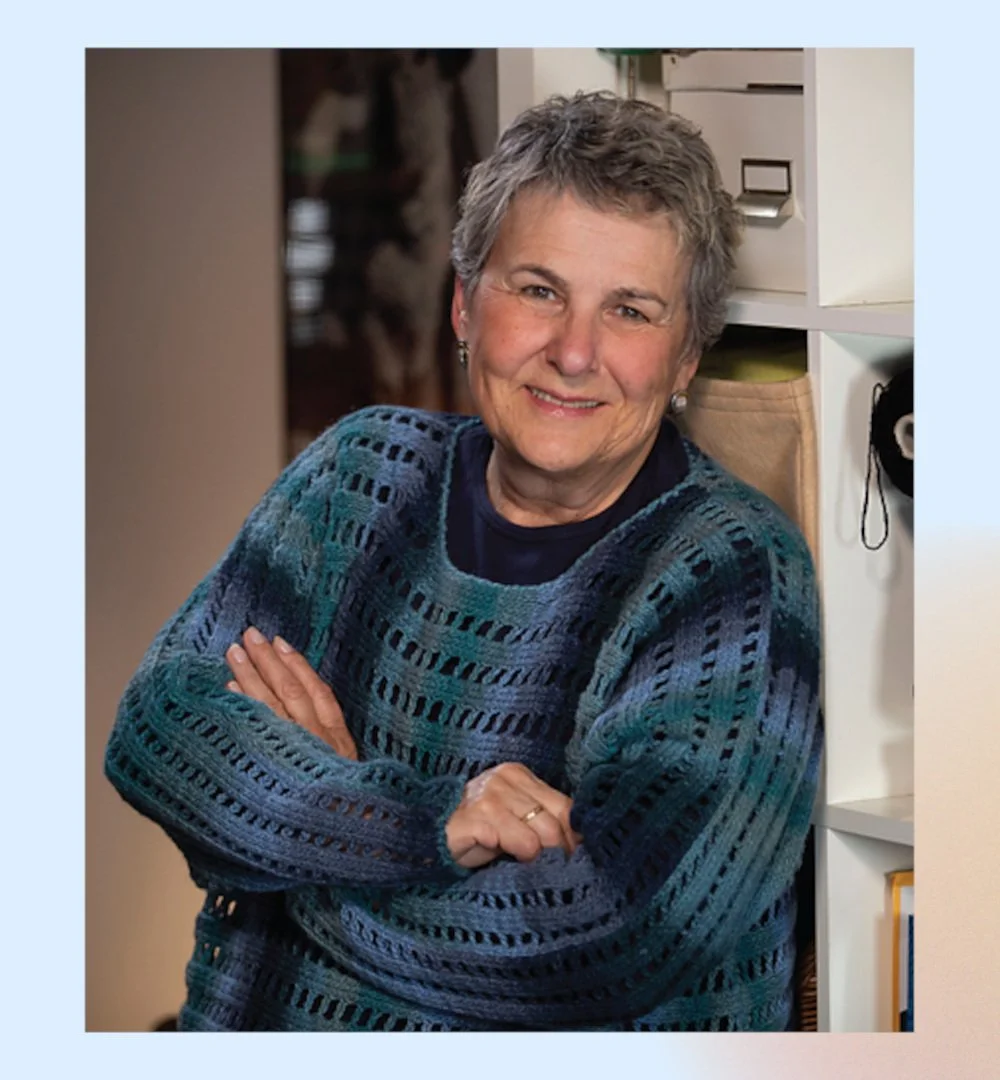
Back in December 2019, my friend Susan Guagliumi joined one of the Better Sweater chats, the semi-regular get-togethers a group of machine knitters and I held on Zoom. At the time, her book Open Spaces had just been published, and her Open Spaces course had freshly launched.
Susan is a machine knitter, author, and educator with decades of experience across multiple machines. She's full of practical tips, hard-won advice, and loads of fun to talk with. For more Susan, be sure to check the related links below the video.
If you enjoy machine knitting tips, tutorials, and other goodies, I invite you to subscribe on YouTube, where I also publish YT short updates between videos.
Related Links
Books by Susan Guagliumi [my Amazon affiliate link]
Susan's Open Spaces online class [Machine Knit Community]
More classes and patterns from Susan [Craftsy]
Machine Knitting Monthly magazine
Video Transcript
(Transcript was gently edited for clarity. Susan is in plain text; I’m in italics.)
Okay, let me stop you for a second. You actually started with an Irish fisherman sweater. That was your first hand-knit?
When you don't know any better, you don't know any better.
Wow!
That was machine knitter, author, educator, and my friend Susan Guagliumi. Susan's fifth book, Cords and Curls, will be released in the fall. But today, I'm presenting excerpts from a live stream we did in December of 2019. Here we go.
We'll be chatting with Susan Guagliumi. And I have to tell you, I was first introduced to Susan Guagliumi decades ago. She doesn't know this, but of course, through her book. I have it here.
Oh my!
Hand-Manipulated Stitches for Machine Knitters. And decades ago, when I was learning to machine knit, it helped me improve my moves on the knitting machine. It helped me truly understand how stitches are formed, how they can be transformed, and all the wonderful things you can do with them. I know a lot of other people were introduced to Susan that way, too. I think I'm going to stop right there so she can tell us herself about her past and what she has done and all of her accomplishments. So, I'm going to turn this over to Susan Guagliumi.
Oh, where would you like me to start?
I'd like to start — let's start with some personal stuff, a little bit. So, where are you from?
I'm originally from the Boston area. And I like to think that I've shaken most of the Boston accent, but anytime I've been in the Midwest, people have said, "Oh, you're from Boston, aren't you?" You know, so, I guess it's still there.
I didn't know that. I grew up in Pawtucket, Rhode Island. Oh, not really far.
I know Rhode Island.
I know when I hear someone from Rhode Island, my ears perk up. I recognize it. Pick it up right away. Yeah.
So, I lived in the Boston area. When I went to undergraduate school, I was looking for a program in special education, and I ended up in New Haven, Connecticut. Southern Connecticut State, one, had an excellent special ed program; and two, was affordable, which was important to me at the time, as it is to students always. So, I ended up here and married one of my college professors. I'm still in the New Haven area. Yes. It was the '60s, remember? So that kind of thing happened. We're still married all these years later.
So you said he was your professor?
He was my art professor. Yes.
Oh. Interesting. Were you involved with any fiber-related arts at that time?
I always sewed, and I credit experiences at Girl Scout camp with actually giving me the confidence to try all kinds of things. I did basketry as a child and went back to it as an adult. As I said, I sewed. I remember being five years old, and my mother let me play with the sewing machine because it was the only toy in the house I was really interested in. I always made a lot of my own clothes and by the time I got to junior high, I was appalled that the project we were given. It was a gathered skirt, and I was working on a Vogue reversible beach robe for the summer that I had to bring in and show the instructor and say, "Could I please continue with this instead of that awful gathered skirt?" So the sewing goes back a long time for me, and the sewing sort of morphed into quilting and some other fiber arts at the time. So yeah, a lot of fabric and yarn has always been a big part of my life.
Did you knit at the time?
I started knitting — hand knitting — when I was in college. My mother had started an Irish fisherman's sweater for her first grandchild and got bored with it and said, "Maybe you can finish this," and I took it back to school with me and went into a local yarn shop where there was a very gracious lady who didn't say to me, "But you didn't buy the yarn here." She still sat down with me anytime I came in, and when I came across something new in the directions that I didn't understand, she showed it to me. I finished the sweater. I can't say that it was knitted to gauge or that the stitches were particularly consistent, but I did finish the sweater. It left me with the feeling that I could knit. So after that, I started picking up other projects from the beginning and honing my skills a little bit more than I did in finishing Michael's sweater.
Okay, let me stop you for a second. You actually started with an Irish fisherman sweater. That was your first hand knit?
When you don't know any better, you don't know any better.
That's amazing!
I think that as a very young child, I had probably done a garter stitch or a stockinette. I knew how to handle the needles, but I had certainly never slipped stitches onto a cable needle and moved them to the front or the back. And it was just sort of an adventure.
Wow. So, when did you first learn that machine knitting even existed? That that was a thing?
Oh, boy. Well, early on we traded a piece of my husband's artwork with a friend for an old four-harness loom, a floor loom, and I taught myself to use the loom and I was busy weaving.
And I had gone into New York City for one of the industry yarn shows. I had a weaving studio by that time in North Haven, Connecticut. And I went into New York to purchase yarn. And one of the things that they were offering at that show — it was a National Needlework show — was a free workshop on knitting machines. And I thought, well, that might be a really cool thing because you could knit the sleeves onto handwoven garments. And maybe I could combine the two. And how different could it be from a loom?
So I took this afternoon workshop on a Superba knitting machine and I was absolutely hooked because as a weaver you can spend days, many days dressing or setting up a loom only to find out that it really wasn't what you thought you were going to get. And you have to start over. I was just intrigued with the instantaneous results on a knitting machine, that you could have an idea and sit down and five minutes later realize that idea for real, right there in your hands, and see it.
So when I got back from the workshop, I stewed over that machine for a while. I sent the company a letter and told them why they should hire me and that of course I'd be willing to learn the machine.
When I look back on it now I think I had just recently read a book called What Color Is Your Parachute? that basically said create a job you want and then go after it. So, I had finished graduate school and there were no jobs teaching weaving at any of the nearby universities and I thought, "Okay, this might be something I could do." So, I sent a letter and they wrote back and said, "Yeah, we'd like to meet with you." And had an interview.
And the next thing I knew, I had a Superba S48 set up in the living room, one of the earliest of the electronic machines, not without its electronic problems. I wasn't sure at one point, quite frankly, if the cat had peed on the [knitting] bed or if I was having problems with the built-in electronics because all of a sudden I was getting nonsense in the knitted fabric. It turns out it was the electronics, not the cat that I blamed.
So I spent about six weeks listening to the brand-new audio tapes that Superba had just introduced for instruction. I think they saw a time when the internet, or some iteration of it, would take over sales — whether it was going to be mail-order sales or online sales. And they were getting ready for a time when there may not be a local dealer nearby, but someone might have purchased a machine. So, we were testing out these tapes, and I was pretty much the guinea pig.
I've always described the tapes as being done by the same lady that reads children's nursery rhymes, a very high voice and a strong British accent. And at one point she says something on the tapes like, "If you fail to thread the carriage, the result will be bad." Well, with a double-bed machine, it's downright physically dangerous, because when you fail to thread the machine, the weights and everything else fall off right on your feet.
By the time I felt halfway confident, I'd gone through the whole manual for the Superba and I could cast on by myself and make the electronics work most of the time. Then the company sent me a Passap, because that was the other machine that we distributed. And I spent the remainder of that summer, from early June until the end of August [learning Passap]. Then they sent me out on the road to sell machines and to train dealers. So from the very beginning my involvement with knitting machines was about sales and product and training.
And around what year was that?
Early '80s. It's getting closer to 40 years now, I think.
Yeah. I was wondering just because the first electronic machine I had that Superba machine. I actually had it under the label White, so I'm very familiar. Oh yes. So I was just wondering what year that was.
Well, White took over — oh, I think in the early '90s. Maybe '89 or '90. So this I believe was about '82 or '83. I've kind of blocked that out.
So how long were you with that company? Because I know you worked for all the companies at some point.
All right. Well, I stayed with Associated Knitting Machines — Passap and Superba — for a couple of years and then I took a job in New England for the Singer Company and worked with them for about six years. And then I was hired as the education director for Studio by White. And Studio by White was the same machine and group of machines as Singer. They were all Silver Reed machines, so it was a pretty natural fit for me. And then I stayed with them right up until the mid-'90s when we thought that Silver Reed was going to cease production. And as it turns out, they're still producing machines in China.
Yeah. And I have to interject — you know, people always say to me, "What's the best machine?" And the answer that I usually give them is it's the machine you know how to use. It's the machine that you can get support for. It's the machine you're comfortable with. They all do wonderful, wonderful things. And over the years I've seen people who have amassed a huge amount of equipment and not always getting the most knitting done. And I've seen people on a simple LK150 — one of my very favorite machines, actually — doing fabulous things because they really understand how the machine works. For me, that's always been important: knowing why something happens when I press a button makes it a lot easier to press the right button.
Exactly. When did you write your first book? Was it Hand-Manipulated Stitches?
It was Hand-Manipulated Stitches for Machine Knitters. And it was back in the late '80s. I got a letter from Interweave Press. They were looking to start doing some books and they asked if I was interested in doing a machine knitting book. Because I was a contributing editor at Threads magazine, I had to run everything by them first. So I went up to Taunton Press — which was also here in Connecticut — and I said, you know, this is what's happening. And they said, "Oh, no, no. If you're going to write a book, you're going to do it for us." So all of a sudden I had a book contract, and the rest is history.
I don't think I ever realized that Hand-Manipulated Stitches would stay in print as long as it has. It's going on 30 years now. It's an awfully long time for a craft book to still be at the top of the list.
Yeah. Well, hey, it's still relevant. I mean, we still do the very same things.
Well, and we have fewer dealers and resources to go to than we did before. So, it's gratifying when I hear people like you say that it was what really clarified things for them. That's exactly what we were after.
What came after Hand-Manipulated Stitches?
Well, the book finally went out of print after about 10 years and then briefly it was available through Bond Knitting Frames and then ultimately the rights reverted to me. I put the book back into print through print-on-demand, which is a real boon to craft areas that could be orphaned by the big publishers. Major publishers aren't interested in books that might sell a thousand copies a year, but with print-on-demand, it's been possible to keep the book in print.
Once the book came back into print, I think that people realized that I was neither senile nor dead. And I started getting a lot of emails asking questions. They find me. With a name like Guagliumi, I think it's easy to find me, actually. So I went back to my file cabinet and I looked over Hand-Manipulated Stitches and the one thing that I felt I hadn't given enough information on in the first book was the whole concept of bridging — using a holding position to gain full unlimited access to all of the needles on the bed to change stitch size or to add extra rows and so forth. So that gave birth to the second book, which was very catchily titled More Hand-Manipulated Stitches and completely devoted to bridging.
That book did well and I went back to the file cabinet again and sat at the machine and played and in 2008, brought out Hand Knits by Machine, which really focused on taking specific hand knit techniques and transferring them to the machine.
It's interesting — the chapter on entrelac knitting was originally going to be part of Hand-Manipulated Stitches. Taunton Press had set a very finite number of pages for the book and we were already running over. So they said you can cut from every chapter and pare it down, or you can just find one area to cut. And I felt as though entrelac didn't really fit the chapters we had set up for the book. They were very specific to things like transferring stitches, crossing stitches, manipulations that were clearly defined. Entrelac was sort of a stepchild to all of that.
We'd moved since I'd done the first book and I could not find my files anywhere for the method for entrelac. And I knew that I hadn't done any scrapping off or rehanging. I knew that I had done it with bridging. And it's interesting when the logic is clear, things like that come back to you. And I sat at the machine and played for about an hour and had one of those eureka moments. And that was a full chapter in Hand Knits by Machine. So it's back.
Yeah. Yay. I want to say that I think what you just said was very, very important about the logic being there because if you just learn machine knitting by memorization. You know, step one press this button; step two bring the carriage across — you never have a complete understanding of machine knitting. But if the logic is there, then you can reconstruct what you did.
Otherwise it feels like ironing to me. There's no sense of adventure or discovery. And that's always been the real thrill for me, saying, "Well, what if I try it this way? The book says to do this, but what if I don't? What will happen?" And you know, sometimes it's a good thing that happens and sometimes not so good. As I've said to students for years: if you know what you did and you can do it again, it's fabulous. If it's beautiful and you have no idea how it happened, then that's a mistake, because if you can't repeat it, it's worthless. So when you understand what's happening, I think sometimes that makes it a little bit easier to hold on to the information.
All of the information that's in Open Spaces was originally supposed to be a chapter in a totally different book. And when I started experimenting and trying some of the things that I wanted to expand on, I realized that it wasn't going to make it as a chapter in another book. As it is, it ended up being a much longer book than I had sort of budgeted the time to do. What happens when I sit down and start playing at the machine is that business I just said: What if? What if I do this and what if I do that? And when you start to bring in all of the variables — the number of stitches or the number of rows or the direction that you manipulate stitches, how many times you do something before you repeat it — all of those variables usually contribute to new patterns. So this book grew from one what-if to the next and did not end up a chapter in another book. It ended up its own book altogether.
(Transcript continues below the image.)
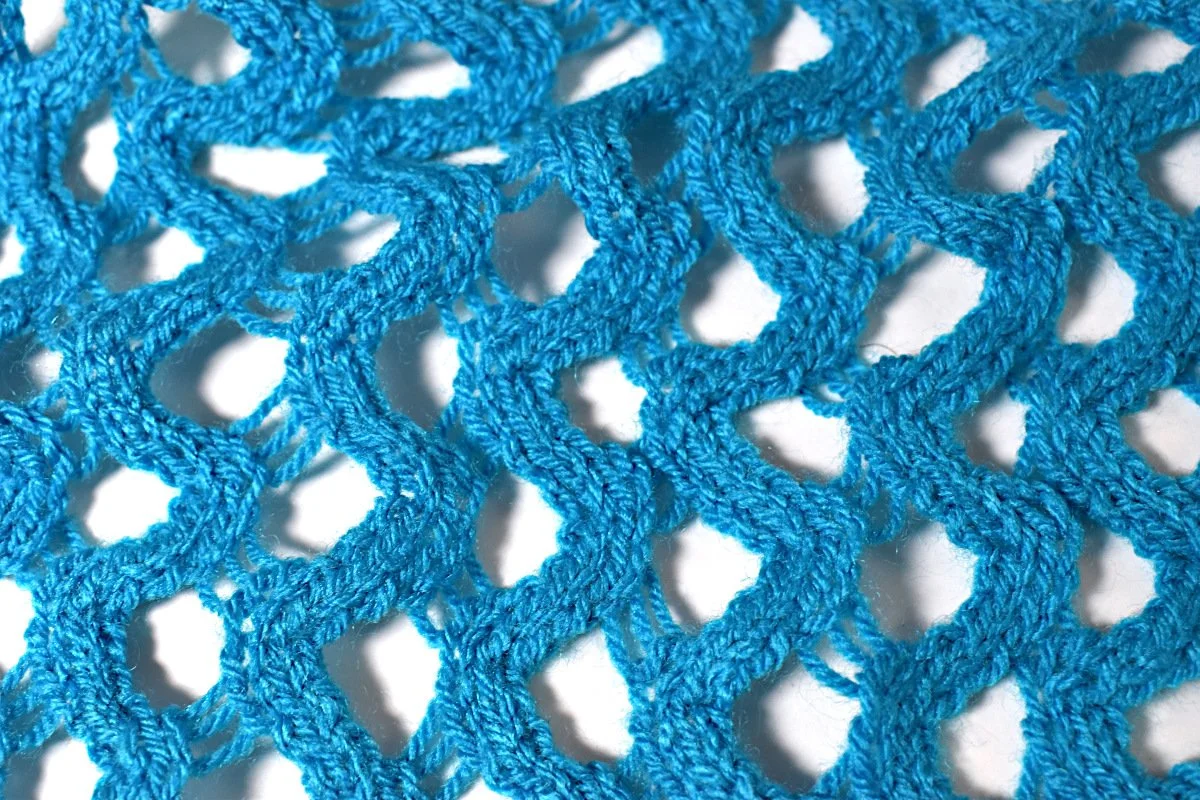
This swatch is based on sample L135 from Open Spaces by Susan Guagliumi. I knitted it on a Silver Reed SK280.
What level of machine knitter would you say you need to be in order to successfully use your books?
Well, the first book — I know that I was the only teacher, via that book, that some people had. So, I would say rank beginners would do okay with that. The other book, More Hand-Manipulated Stitches, I think requires a little more experience because you're going to be using the holding position for some short rowing and some bridging. Hand Knits by Machine could be for a fairly new knitter, and even with Open Spaces I think that if you're willing to make some mistakes and to experiment and to try things, I think even a beginner will find things in the book that are fully manageable.
Children, all children, expect to make mistakes and they don't let it defeat them. And so many times I'll see adults that will throw up their hands the first time they drop stitches and say, "I can't do this. I can't do this. I've tried. I can't do this." Whereas a kid will say, you know, I'm not going to let that happen again. I'm going to find out why it happened and I'm going to keep on trying. If you're willing to try something and accept that it isn't always going to be a finished something, then I think there's a lot there even for a beginner.
Oh, definitely. And I think that through mistakes, you learn.
My best teachers were my worst mistakes. Absolutely. And I've made some doozies. I mean, every now and then, when I'm out on the road teaching, I've brought samples with me. I've brought the finished project so people can say, "Isn't that terrific?" And then I'll show them the half-dozen failures that led up to that project. And hopefully you learn something from each failure. Next time I'm going to change the stitch size. Next time I'm not going to change colors or I'm not going to introduce a fancy trim. Whatever it was that didn't work in the previous example, you just keep trying, right?
I've been experimenting with Open Spaces and here's my experiment with skipping needles. With needles out of work and then keeping all the needles in work. You probably can't tell on this.
(Transcript continues below the image.)
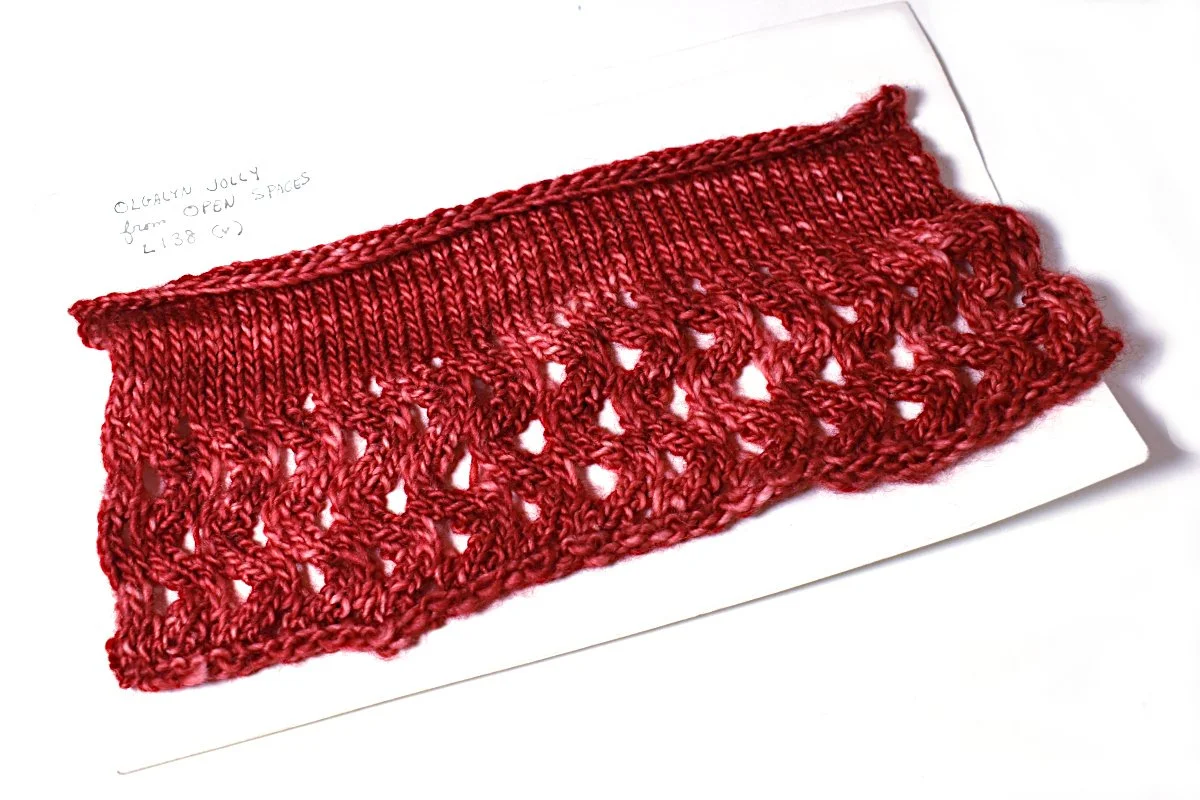
I knitted this variation of sample L138 from Open Spaces on a Passap DM80.
Very nice. That one looks almost like raffia. The red one.
Oh, it's actually 100% wool.
Oh, it's got a shine on it on my monitor. Yeah. Yeah. I thought, gee, it's raffia.
It's a subtle difference, but you know, I love experimenting. And I love in your course how you encourage people to try it this way, try it that way, and all the variations that you can do. So I guess this means that you're a process knitter as opposed to a product knitter?
I definitely am. And I hadn't really thought about that until this last year. For me, the process is what I find so exciting. Sometimes I'll say that by the time I've done the second sleeve on a sweater, I feel like I'm a production knitter. And yet the sweater that I've got on — in fact, this is the third time I knitted it because one of the first examples wasn't drying fast enough. I wash everything when it's done. And I thought, well, I'll just tumble it in the washer. And it had so much alpaca and mohair in the blend that the darn thing felted and it would fit an American Girl doll. It sure wasn't going to fit me. I donated it along with some of the sweaters that went to FIT for the students to cut up this year. I just couldn't bear to look at it.
Oh wow.
Yeah. Sometimes you try things a couple of times and you don't make the same mistake the next time. Hopefully.
Yeah. Oh, so could you stand up and show everyone your sweater?
Can you see it?
Yes. Yes. So gorgeous. Yes.
And this is another one of those sweaters with all the open spaces that you really do have to wear something underneath it unless you're looking to get arrested walking down the street.
Is that stitch pattern in the course?
It's going to be in an upcoming issue of Machine Knitting Monthly, the British magazine along with some information on creating a really good needle pusher for the arrangement that I needed to use over and over again. Periodically, I share patterns with Machine Knitting Monthly just because it's the last magazine left. The more of us that support it, the healthier this fading industry will be.
Yeah. I recall those — what are they? — Jac 40s?
Those needle pushers. Oh, wouldn't I love to have one of those now?
Yes. I mean, some of the toys that used to be available. What I did to make a needle pusher was to make, oh, how can I explain this? Do you know those scrunchy things that they used to use to pull all your hair back?
The one with teeth or they're almost like clips?
It's a long one. But it's a long comb-like thing. Well, if you put that on the needles first and then you glue two pieces of wood over the end of it — it's set up for the gauge of your machine.
Oh my goodness.
And then if you cut out the ones you don't want, you have this quick needle pusher. Having the right tools makes it a whole lot easier to do a lot of hand-manipulated stitches. Without the right tools, it would be too labor-intensive to do something like the sweater I've got on.
I would like to open up questions to the people who are watching this. If you could put the questions in the Q&A section, it makes it easier for us to read.
I hope so.
Yeah. For those of you who don't know, I met Susan at a meeting for FIT, Fashion Institute of Technology. I believe we started teaching there the same semester. We never actually taught on the same day until last semester. In fact, we were actually co-teachers for a course, which was sort of fun to compare notes and discuss our students together.
I see Ruth says, "Hi, ladies. And Susan, could you pan your workspace for all?" So, she'd like to see your wonderful workspace.
Just trying to think how I can do that. Let's see if I move the computer a little forward.
I was afraid it was going to be really raining hard like it was earlier. We're in a post-and-beam house, so the slanted ceiling up there goes right up to the roof line. And when the rain really pounds down, you can hear it. On one wall over this way, there are yarn cubbies. That's pretty much my entire stash. I'm not a hoarder. I tend to buy for projects. I mean, I have some stuff left over, but I'm not a real hoarder.
And then the table in the middle is my cutting table for sewing and for laying out projects. And the drawers underneath — there are three sets of drawers that were old Simplicity sewing pattern chests that I had way back when my sister-in-law and I had a yarn shop. We used it for storage. I've got just a Formica top on those.
Okay, over on this side there are some IKEA drawers and things everywhere, the best storage space. I've got one machine here and another one towards the very back of the white table. And then in the corner there's a sewing machine, a serger, and my new coverstitch machine that I just love, love, love, love. And an iron. And the iron that I've been devoted to the last few years is from Reliable Corporation, and it's a real high-steam kind of iron. And that's it. It's a pretty nice room. I feel very lucky to have this much space, but we built this house with that in mind — that Arthur and I would both have studio space. So, that's where I live.
Great!
"What and where to oil on the machine and how often?" That's a great question, Honey.
From the machine's point of view, you can't over-oil it. From the yarn's point of view, you need to be fairly careful so that you don't end up with oil in the yarn. But you want to oil the tracks underneath the carriage. In fact, can I just grab a carriage for a second?
What you want to oil under here are the striking edges, not the base plate, because the needles should never contact the base of the carriage. But it's the edges of these cams that need to be oiled so that as the needle butts slide through, they're getting a good oil. And you want to oil the rail on the back of the carriage and the rail on the machine, as well as the gliding edge up here in the front. So the carriage needs to be well-oiled and lint-free.
I use a can of canned air and I hold the carriage over a wastebasket and then spray. I'm laughing because the first couple of times I did this, I didn't think in advance that I was going to be spraying out all this greasy lint, which then ended up all over the table, the white table behind me, with grease marks, and all over me. So try to hold it either in a paper bag or over a wastebasket when you start spraying with canned air. And then on the machine, you want to oil the rail at the back, as I said, the very front edge where the carriage glides along, and the needle butts. And usually what I'll do is bring all of my needles into working position, run some oil across the butts of the needles, and then run the carriage back and forth a few times. If you see extra oil sitting on the surface of the bed, wipe it up. You certainly don't want any oil to come forward where the hooks of the needles are.
What about Passap machines? They need a little extra oil. Do you want to talk about that?
Oh. It's been a long time since I've oiled a Passap. But on the Passap, you've got the pushers and the needle butts, and those all need to be oiled. And particularly with the older Passaps, with any older machine, you can be sure that it's going to drink up oil like crazy. So, I would say you probably want to oil just about every time you use it.
Here's a question from Patrizia, who asks, "What coverstitch machine do you use?"
Oh, I just bought a Janome, and I'm really loving it, but it takes some practice. I can't seem to get that looper thread to let go of the stitch finger at the back. I've snapped a few stitches. I'm learning. I'm learning. And I'm trying to force myself to play with fabric scraps instead of jumping right into the project I really wanted to do.
You know, the very first time I sat down to use a serger, I was working for Studio by White and we were bringing a low-end White serger into the line for knitters to purchase. And I had a bathing suit — and very fortunately that year I had lost some weight — and I thought, well, I'm going to take in the bathing suit. I'm going to shoot this phone. I thought I was going to take in the bathing suit and instead what I did was cut the crotch right off of it because I wasn't careful with the knives. So, it's always a good idea to practice a new skill on something that isn't terribly important, because I certainly couldn't wear that bathing suit by the time I was done with it. So, I'm going to practice more with the coverstitch machine, too. It's still fairly new.
Well, you got your practice!
Margaret asks, “What machine do you use most often?”
The machine that I use the most often is not generally available right now. It's a Silver Reed 860, which is a mid-gauge. And I like it because a lot of the hand-manipulated techniques show up better than they would in standard gauge. And they're not as big — I can't think of a better word for it — as big and clumsy-looking as they sometimes are on a chunky machine. I also love the fact that it has 150 needles instead of 110 and I can still use worsted weight yarn with it.
I think the gauge is one of the reasons that I also like that LK150 so much. It's another mid-gauge machine. It'll always be a manual machine. It will never have a ribber. But it's that mid-gauge and it lets you use all of the hand knit yarns.
I'm a real yarn snob, I'm afraid. I'm just not thrilled with most of the acrylic yarns I've seen over the years. I used to joke that why would I wear a plastic bag? I wouldn't wear a plastic bag, so why should I wear an acrylic sweater? And one year at the summer camp we did for Studio, people gave me a very beautifully decorated plastic bag to wear as a result. In fact, I think there are pictures of that lovely outfit on my website. So, if you're interested in my plastic bag outfit, you can check it out there.
I like being able to go into the local yarn shop and find really beautiful yarns. And I don't mind working off of balls. I weave in my ends as I go, so I don't have a whole lot of ends to work with. And I don't worry necessarily if it's on cones.
Could you describe your process for weaving in ends on balls as you go along?
What I'll do when I finish with one ball of yarn — I've got a tail hanging out — I'll bring maybe a dozen needles at the edge out to holding position. And then literally weave the yarn over one needle shaft, under the next. Over, under, over, under. So, picture this if you will. It's in front of the gate pegs or the sinker posts. It's not back behind that area where it wouldn't knit. And then I'll knit the next row and immediately weave in that end in the same way. So when I'm done, my ends have all been woven through for several inches and I can clip them off.
The only time that won't work is with fairisle, or it can be a problem if the purl side is going to be the right side of the garment. In fact, I have a fabulous striped sweater that I don't wear, um, because I wove in all the ends when I was doing it and then decided that I liked the purl side better. And yeah, it's a nice stripe, but it would have been fabulous on the purl side as the right side if I hadn't woven in all the ends. So, samples. I'm probably my own worst candidate for following my own advice, but sample everything before you get going on a whole sweater.
What is the best oil to use?
Oh, well, I don't like silicone. And in fact, I had used it on a machine once that I had to go back with fine steel wool to get it off. Oil homogenizes and the easiest way to get old oil off is to put new oil on, wipe it down, and then re-oil the machine. That'll always do it. You'll get some black, which is carbon, that builds up with metal striking metal. So if you can buy knitting machine oil, buy knitting machine oil. Otherwise, gun oil, unfortunately. I cringe when I go in to buy it because I'm not a gun rights person, and showing up in Dick's to buy gun oil was sort of against my… They sell two types of gun oil, I've been told, one smells terrible, and the other one doesn't. So when you go in to buy gun oil, you could ask for the one that is easier to live with. So, gun oil or knitting machine oil.
We were talking about your weaving, Susan. And Mindy asks if you still weave. And she says, "I'm a knitter, hand and machine, Rochester spinner, and I sew, but now learning to weave."
Interesting.
Do you still weave?
I've gone back to weaving in small bits. I did some small tapestry pieces and I've got it in my head that now that I'm not going to be traveling as much that I'd like to do a tapestry. And you know I showed you that nice high ceiling before. I'm thinking that it's perfect for a warp-weighted loom. So I'm hoping, (if not this winter, then maybe over the summer when the air conditioning is on and I don't want to be outside) to set up a tapestry to hang from the ceiling.
Oh, Terry says, "Hi, Susan and Olga. Thanks for doing this." Susan, I know that the best machine is the one that works for you, but when you're asked for a total newbie, which machine do you recommend that they start with? A new LK150?
A lot of it depends on what resources you have nearby. If you've got a knit club nearby that's active, you're going to have a bunch of older knitters that'll be dying to show you how to use every gizmo and gadget that ever was, and to make wonderful increases and non-roll edgings and everything else. But if you're on your own without knitters nearby, I would say to start slowly and yeah, I think the LK150 is a terrific machine to start with.
The three classes that I did for Craftsy, I used just that machine because I feel as though it's the lowest common denominator. It does everything that all machines do except it does it manually. Once you understand how patterns are formed on a machine, I think it's an easier transference to learn how to use a punch card or an electronic.
And with some of the electronics, components are no longer available. So if you buy an electronic machine at this point, I think you need to plan on investing in DesignaKnit software, which is pricey, and with the computer, the cable that will hook it up from the computer to the machine. You're going to need to be working on a PC with software and a cable. So I just don't think any of the other electronics are dependable enough at this point to go without it.
Punch card machines, you can't go wrong. They're mechanical machines and they're easier and less expensive to fix. So, I still can't tell you that any one machine is any better than another. You know, you might find a used Toyota from the '80s that's in pristine condition, great machine. And you might find a Brother from the '90s that's had hard wear, and you'll be sorry to have invested in it. Be careful of eBay, please.
Here's another question. It says, "Hi, Susan. Thank you for this session." This is from Linda.
I'm reading that now, yeah.
"I'm a complete beginner and have purchased a Silver Reed 360 from 1978." I had that machine too.
We all did.
Yeah. Under Singer, in those days. "It's in excellent condition and has a 4.5 needle setting." I guess you mean the gauge, the millimeter. “I wondered what the maximum bulk is that one can use with the machine with a nice drape of fabric."
Okay. Every machine is calibrated to work its very best right in the middle of the stitch dial. So the yarns that knit on stitch size six or seven or eight on that machine are the ones that are going to have the best drape and be the easiest to work with, and that includes fingering and lace weight yarn.
When you start to get heavier than that into a sport weight or a DK, the machine may knit them, but it's not happy doing it, and it's not what the machine does best. You can work on every other needle. You still will have to knit a little slower, use some extra weights, and be aware of the fact that you're going from a 200-needle bed down to a 100-needle bed. Depending on what gauge you get… Let's say you're using a worsted on every other needle, you've got a hundred needles; if you're getting five stitches to the inch, you're only going to get a piece 20 inches wide. So you're going to cut your size potential, and any punch card patterning would have to be repunched for every other needle. So if what you want are heavier yarns, then you're probably going to want to look for another machine at some point.
And that LK150 would be a great accessory to have on the side with the standard gauge. You'd think that I made money on these. I don't. I just really love that machine. And as a second machine, you know, they sell for I think under $400 right now. So, it gives you access to more yarns. You know, all of us have ended up owning more than one machine because of those limitations.
The mid-gauge machines were designed for DK yarn to knit on stitch size five and for worsted to knit on a seven or an eight. I could get heavier. I've used Lopi on every other needle. It's like you're in the rug business. It's not drapey and wearable. But on the other hand, if you wanted to use Lopi on a bulky machine, then you could knit a hair shirt, but you can knit something a little bit heavier that way.
Ruth asks, "I've been told." Oh, actually, it's a statement, an interesting statement. "I've been told that when not using the machine, put the tension dial at zero so you don't stretch the spring inside." I've never heard that before.
I've never heard it either, but it couldn't hurt as long as you remember to put it back afterwards, right?
I may start doing that.
Yeah, the other thing on an unused machine would be to take out the sponge bar, depending on the machine. Now, with my Silver Reed machines, the needles stay right where they are. With the Brother machines and the Taitexma machines I've been using at FIT, I've noticed that when the sponge bar is out, the needles tend to want to pop up. So, I'd just keep an eye on that. But the sponge bars wear down terribly fast. And that might be something to keep in mind. If you're not going to get back to your knitting right away and you're going to leave it on the machine, take the weights off. If it's a long piece, an afghan or something, that you're coming back to in a day, put a chair up close and let the knitting rest on the chair so it's not hanging with its own weight.
Yes. I've heard if you do remove the sponge bar from the machine, that it should be wrapped in plastic so it doesn't dry out. Have you heard that?
They do dry out. And in fact, the project that I'm starting right now — I'm starting another video project. I thought, well, I can't just do these examples. This is very project-oriented, not process for a change. I should do them for mid-gauge and bulky and for standard gauge. So, I took my standard gauge back out and I was appalled because it was like the sponge had just disappeared. It was so flat. I couldn't even begin to use the machine. So, I just ordered two sponges. And I'll keep one of them wrapped up in Saran Wrap until I need it. So yeah, definitely close it up because they will flatten out and dry out otherwise.
"A Happy New Year, and a thank you," Olgalyn.
Oh, Happy New Year, Susan, and happy new year to everyone who joined us this evening. Thank you so much. I love talking machine knitting. It's so great to have the opportunity to talk machine knitting with all these machine knitters and people who are interested in machine knitting. So everyone, happy stitching, and we'll have another Better Sweater Chat sometime soon.
Thanks, Susan.
Thanks for having me.